


In production environments where product models frequently change, how does a double-platform fully automatic screw machine achieve rapid changeover and flexible production by changing fixtures?
Release Time : 2026-04-13
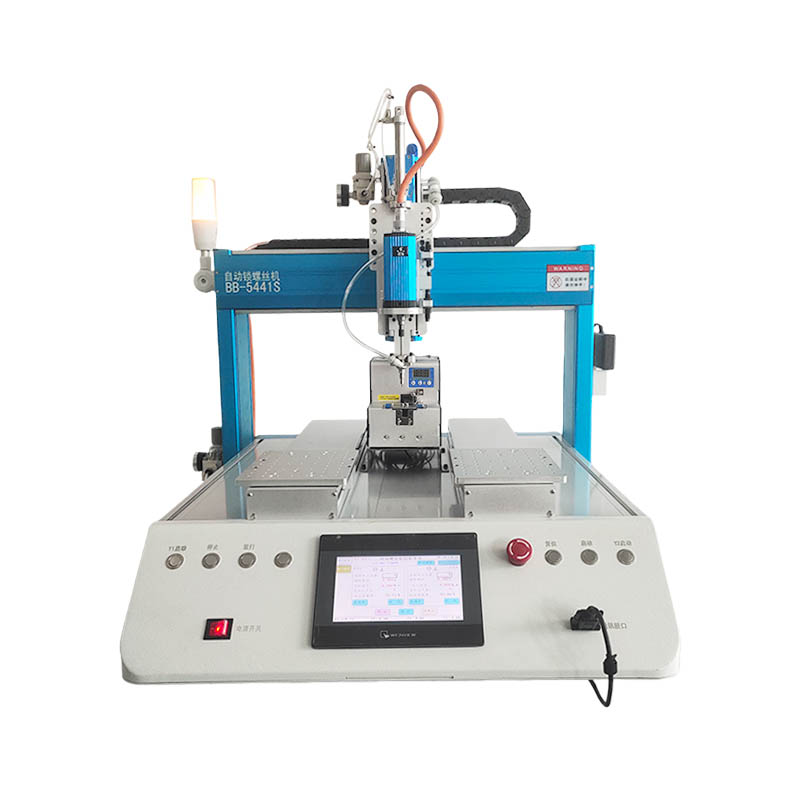
In industries such as consumer electronics, product updates are rapid and models are diverse, requiring production lines to possess high flexibility and rapid response capabilities. The double-platform fully automatic screw machine, with its structural and modular design advantages, can achieve rapid changeover between different products by changing fixtures, thus meeting the production needs of multi-variety, small-batch production. This fixture-centric changeover method significantly shortens changeover time and improves equipment utilization.
1. Modular Design Enables Rapid Changeover
Double-platform fully automatic screw machines typically employ a modular structural design, functionally dividing the fixtures, screw feeding system, and locking unit. The fixtures, as key components that directly contact the product, are designed for rapid disassembly and assembly. For example, using a positioning pin + locking mechanism allows operators to complete changes without complex tools. This standardized interface design provides the hardware foundation for rapid changeover.
2. Dual-Platform Structure Improves Changeover Efficiency
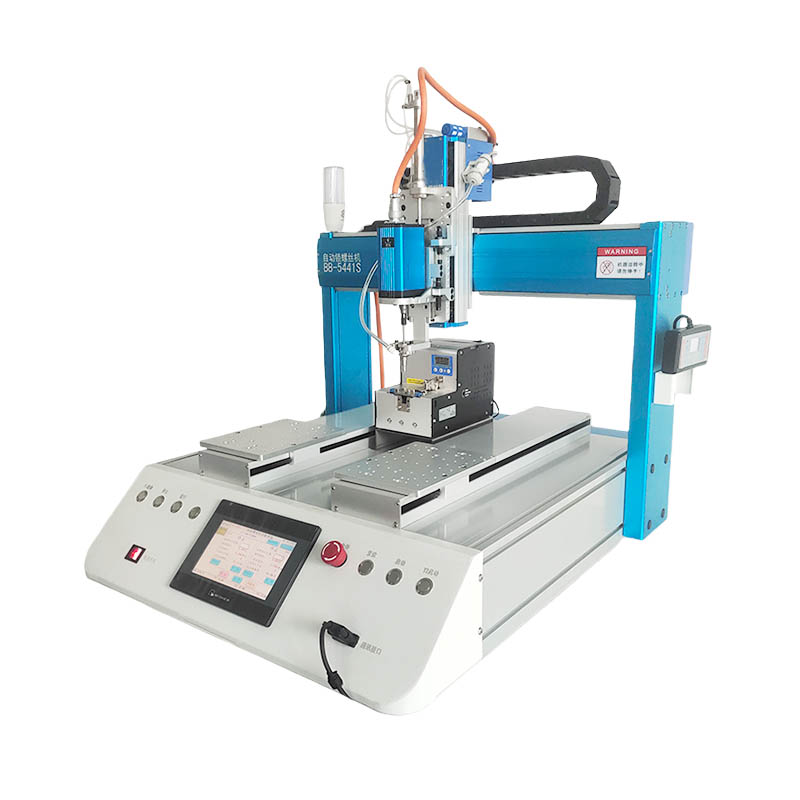
Compared to single-platform equipment, the dual-platform structure has significant advantages. While fastening operations are performed on one platform, another platform can be used for loading or fixture changes, achieving "production while preparation." When product switching is required, the new fixture can be installed and debugged on an idle platform first, and then switched immediately after the current batch is completed, significantly reducing downtime and improving overall production efficiency.

3. Combination of Universality and Specialization in Fixture Design
To accommodate diverse products, fixture design typically balances universality and specialization. On the one hand, adjustable structures achieve dimensional compatibility within a certain range; on the other hand, specialized designs are used for critical positioning points to ensure assembly accuracy. This "semi-universal" fixture solution reduces the types of fixtures while ensuring fastening quality for different products, making it an important means of achieving flexible production.
4. Rapid Parameter Recall and Program Switching
When changing fixtures, the equipment control system must also synchronously switch to the corresponding fastening program. Modern screw fastening machines are usually equipped with a human-machine interface (HMI) that can pre-store various product parameters, including fastening position, torque, and speed. Operators only need to select the corresponding model to automatically load the parameters, avoiding repetitive manual settings. This rapid software-level switchover, synergistic with hardware fixture replacement, improves overall switchover efficiency.
5. Reduced Debugging Time and Operational Difficulty
Through the combination of standardized fixtures and pre-set programs, debugging time for new product introductions is significantly reduced. Operators no longer need complex positioning and parameter calibration; simple confirmation is all that's required before production begins. Furthermore, the modular design reduces reliance on operator skills, making the production process more stable and reliable, and reducing quality risks caused by human error.
6. Enhanced Production Line Flexibility and Market Response Capability
In multi-variety, small-batch production models, rapid switchover capability directly impacts a company's delivery efficiency. The double-platform fully automatic screw machine, through fixture replacement, enables flexible production, allowing companies to quickly respond to order changes and flexibly arrange production plans. Simultaneously, increased equipment utilization reduces unit production costs and enhances market competitiveness.
7. Facing the Development Trend of Smart Manufacturing
With the development of smart manufacturing, fixture replacement is evolving towards automation and intelligence. For example, identification systems can automatically determine product models and match corresponding programs, or quick-change mechanisms can be combined to achieve semi-automatic or even fully automatic fixture switching. This will further reduce manual intervention, making the advantages of the double-platform screw machine in flexible production even more prominent.
In summary, the double-platform fully automatic screw machine achieves efficient product model switching capabilities through modular fixture design, dual-station collaboration, and rapid program switching. This fixture-centric flexible production model not only improves production efficiency but also provides strong support for enterprises to cope with ever-changing market demands.
1. Modular Design Enables Rapid Changeover
Double-platform fully automatic screw machines typically employ a modular structural design, functionally dividing the fixtures, screw feeding system, and locking unit. The fixtures, as key components that directly contact the product, are designed for rapid disassembly and assembly. For example, using a positioning pin + locking mechanism allows operators to complete changes without complex tools. This standardized interface design provides the hardware foundation for rapid changeover.
2. Dual-Platform Structure Improves Changeover Efficiency
Compared to single-platform equipment, the dual-platform structure has significant advantages. While fastening operations are performed on one platform, another platform can be used for loading or fixture changes, achieving "production while preparation." When product switching is required, the new fixture can be installed and debugged on an idle platform first, and then switched immediately after the current batch is completed, significantly reducing downtime and improving overall production efficiency.
3. Combination of Universality and Specialization in Fixture Design
To accommodate diverse products, fixture design typically balances universality and specialization. On the one hand, adjustable structures achieve dimensional compatibility within a certain range; on the other hand, specialized designs are used for critical positioning points to ensure assembly accuracy. This "semi-universal" fixture solution reduces the types of fixtures while ensuring fastening quality for different products, making it an important means of achieving flexible production.
4. Rapid Parameter Recall and Program Switching
When changing fixtures, the equipment control system must also synchronously switch to the corresponding fastening program. Modern screw fastening machines are usually equipped with a human-machine interface (HMI) that can pre-store various product parameters, including fastening position, torque, and speed. Operators only need to select the corresponding model to automatically load the parameters, avoiding repetitive manual settings. This rapid software-level switchover, synergistic with hardware fixture replacement, improves overall switchover efficiency.
5. Reduced Debugging Time and Operational Difficulty
Through the combination of standardized fixtures and pre-set programs, debugging time for new product introductions is significantly reduced. Operators no longer need complex positioning and parameter calibration; simple confirmation is all that's required before production begins. Furthermore, the modular design reduces reliance on operator skills, making the production process more stable and reliable, and reducing quality risks caused by human error.
6. Enhanced Production Line Flexibility and Market Response Capability
In multi-variety, small-batch production models, rapid switchover capability directly impacts a company's delivery efficiency. The double-platform fully automatic screw machine, through fixture replacement, enables flexible production, allowing companies to quickly respond to order changes and flexibly arrange production plans. Simultaneously, increased equipment utilization reduces unit production costs and enhances market competitiveness.
7. Facing the Development Trend of Smart Manufacturing
With the development of smart manufacturing, fixture replacement is evolving towards automation and intelligence. For example, identification systems can automatically determine product models and match corresponding programs, or quick-change mechanisms can be combined to achieve semi-automatic or even fully automatic fixture switching. This will further reduce manual intervention, making the advantages of the double-platform screw machine in flexible production even more prominent.
In summary, the double-platform fully automatic screw machine achieves efficient product model switching capabilities through modular fixture design, dual-station collaboration, and rapid program switching. This fixture-centric flexible production model not only improves production efficiency but also provides strong support for enterprises to cope with ever-changing market demands.