


How does the dual-station design of the Double Platform Fully Automatic Screw Machine improve screw-tightening efficiency in consumer electronics?
Release Time : 2026-08-20
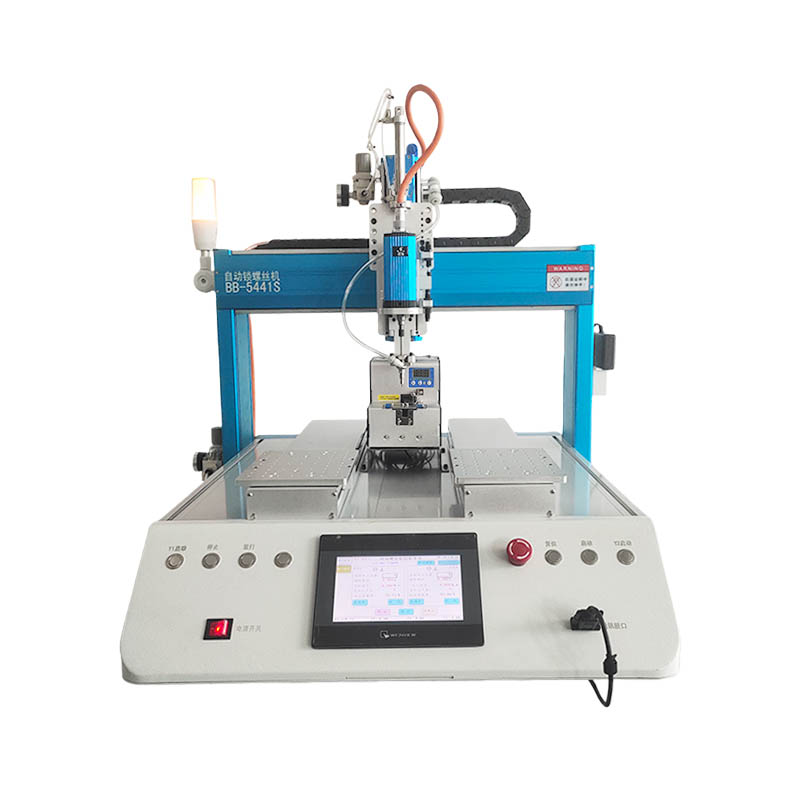
In the assembly process of consumer electronics products such as mobile phones, tablets, cameras, keyboards, and smart wearable devices, screw tightening is a crucial step. Traditional single-platform machines require waiting for the machine to reset after each tightening operation, followed by operator removal of the finished product and placement of a new workpiece, resulting in waiting time. The Double Platform Fully Automatic Screw Machine utilizes dual Y-axis platforms for alternating operation. While one worktable is loading and unloading products, the other worktable can simultaneously complete screw tightening, reducing idle time and making the entire production process more continuous.
1. Simultaneous Loading/Unloading and Tightening
The core advantage of the dual-platform design lies in maximizing machine uptime. When one platform is engaged in the screw-tightening process, the operator can prepare the other platform for workpiece loading, unloading, and positioning. Once the first workpiece is completed, the machine can quickly switch to the other platform to continue working. This alternating mode reduces waiting time between manual loading/unloading and machine processing, helping to shorten the overall processing cycle of a single product, making it particularly suitable for the batch and continuous production needs of the consumer electronics industry.
2. Precise Motion Ensures High-Quality Screw Fastening
In addition to its dual-station structure, this equipment utilizes stepper motors in conjunction with synchronous belts or servo motors and lead screws in its X, Y, and Z axis motion systems, along with an automatic error compensation mechanism. This ensures excellent positioning accuracy and stability during high-speed operation. For precision electronic products such as mobile phones, cameras, and laptops, screw holes are typically very compact, requiring precise screw fastening positions. Stable multi-axis motion helps the screwdriver accurately reach the designated position, improving the consistency of the automated fastening process.
3. Efficient Feeding Reduces Manual Intervention
The equipment employs a rotary screw feeder mechanism with a small four-segment indexing structure, enabling stable screw feeding. The feeding process is smooth and low-noise, reducing the impact of frequent manual replenishment and adjustments. Simultaneously, the vacuum screw feeder system expands the equipment's applicability to different screw specifications, covering the assembly needs of more consumer electronics products and providing reliable support for continuous automated fastening.
4. Multi-Program Storage Improves Changeover Efficiency
Production lines frequently require product changeovers when dealing with different electronic product models. The equipment is equipped with a DPS and a handheld programmer, supporting program writing and cloning, and can internally store a large number of screw feeding programs. After programming and saving a product once, the corresponding program can be directly called in subsequent production, reducing repeated debugging time. Combined with the interchangeable fixture design, it further enhances the equipment's adaptability to multi-variety production environments.
5. Real-time Monitoring Enhances Production Management
The equipment adopts an automatic screw tightening control system and dynamically displays the operating status through a Chinese operating interface. The tightening result of each screw can be recorded in real time, distinguishing between OK and NG statuses. This not only facilitates timely detection of anomalies by operators but also helps improve the traceability of the product assembly process. For consumer electronics production lines that require strict control of assembly quality, this real-time monitoring can reduce problems such as missed screws and incorrect screw tightening.
Overall, the Double Platform Fully Automatic Screw Machine effectively connects product loading and unloading with screw tightening through functions such as alternating dual Y-axis operation, precise multi-axis motion, efficient feeding, program storage, and real-time monitoring. The dual-station structure particularly reduces equipment waiting time and increases the effective work ratio per unit time. For mass assembly of consumer electronics products, it not only helps improve screw fastening efficiency, but also enhances the stability, consistency and automation of the production process.
1. Simultaneous Loading/Unloading and Tightening
The core advantage of the dual-platform design lies in maximizing machine uptime. When one platform is engaged in the screw-tightening process, the operator can prepare the other platform for workpiece loading, unloading, and positioning. Once the first workpiece is completed, the machine can quickly switch to the other platform to continue working. This alternating mode reduces waiting time between manual loading/unloading and machine processing, helping to shorten the overall processing cycle of a single product, making it particularly suitable for the batch and continuous production needs of the consumer electronics industry.
2. Precise Motion Ensures High-Quality Screw Fastening
In addition to its dual-station structure, this equipment utilizes stepper motors in conjunction with synchronous belts or servo motors and lead screws in its X, Y, and Z axis motion systems, along with an automatic error compensation mechanism. This ensures excellent positioning accuracy and stability during high-speed operation. For precision electronic products such as mobile phones, cameras, and laptops, screw holes are typically very compact, requiring precise screw fastening positions. Stable multi-axis motion helps the screwdriver accurately reach the designated position, improving the consistency of the automated fastening process.
3. Efficient Feeding Reduces Manual Intervention
The equipment employs a rotary screw feeder mechanism with a small four-segment indexing structure, enabling stable screw feeding. The feeding process is smooth and low-noise, reducing the impact of frequent manual replenishment and adjustments. Simultaneously, the vacuum screw feeder system expands the equipment's applicability to different screw specifications, covering the assembly needs of more consumer electronics products and providing reliable support for continuous automated fastening.
4. Multi-Program Storage Improves Changeover Efficiency
Production lines frequently require product changeovers when dealing with different electronic product models. The equipment is equipped with a DPS and a handheld programmer, supporting program writing and cloning, and can internally store a large number of screw feeding programs. After programming and saving a product once, the corresponding program can be directly called in subsequent production, reducing repeated debugging time. Combined with the interchangeable fixture design, it further enhances the equipment's adaptability to multi-variety production environments.
5. Real-time Monitoring Enhances Production Management
The equipment adopts an automatic screw tightening control system and dynamically displays the operating status through a Chinese operating interface. The tightening result of each screw can be recorded in real time, distinguishing between OK and NG statuses. This not only facilitates timely detection of anomalies by operators but also helps improve the traceability of the product assembly process. For consumer electronics production lines that require strict control of assembly quality, this real-time monitoring can reduce problems such as missed screws and incorrect screw tightening.
Overall, the Double Platform Fully Automatic Screw Machine effectively connects product loading and unloading with screw tightening through functions such as alternating dual Y-axis operation, precise multi-axis motion, efficient feeding, program storage, and real-time monitoring. The dual-station structure particularly reduces equipment waiting time and increases the effective work ratio per unit time. For mass assembly of consumer electronics products, it not only helps improve screw fastening efficiency, but also enhances the stability, consistency and automation of the production process.