


How does a Light Source Controller improve image clarity in visual inspection of moving objects through high-speed strobe control?
Release Time : 2026-08-14
On automated production lines, machine vision systems frequently need to locate, measure, identify defects, and assess the quality of products moving at high speeds. The faster the movement, the more prone ordinary continuous light sources are to problems like motion blur and edge blurring, affecting the accuracy of visual algorithms. A Light Source Controller, through high-speed strobe control, provides instantaneous stable illumination at critical points in the camera exposure, effectively improving the imaging of moving objects and providing a clearer image foundation for high-speed visual inspection.
1. High-speed strobe reduces motion blur
Moving objects move continuously during camera exposure. If the exposure time is long, even with sufficient light source brightness, the object's position will change during imaging, resulting in noticeable motion blur.
High-speed strobe control allows the light source to illuminate only for a very short time window, significantly reducing the time the object is illuminated. Combined with the camera's exposure trigger signal, this effectively "freezes" the motion state, making the outline and edges of fast-moving workpieces appear clearer in the image.
2. Rapid Response Enhances Trigger Synchronization
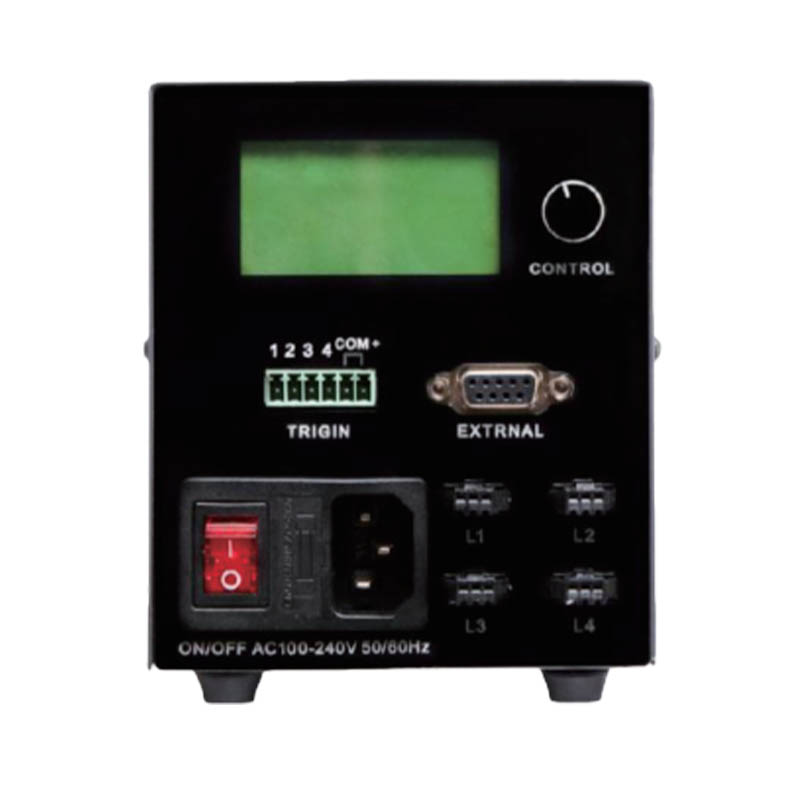
High-speed visual inspection requires not only rapid light source illumination but also a stable and timely trigger response from the Light Source Controller. The Light Source Controller incorporates a high-speed optical coupler, improving the response speed between external trigger signals and light source movement.
When the sensor detects the product entering the designated position, the controller quickly responds to the trigger signal and completes strobe illumination within the camera's exposure window. This closer synchronization between the light source, camera, and the object being measured helps reduce imaging deviations caused by time differences between different devices.

3. Instantaneous High Brightness Improves Detail Representation
For high-speed moving parts, simply shortening the exposure time may result in insufficient light entering the camera, leading to decreased image brightness and loss of detail. High-speed strobe control can provide strong instantaneous illumination for a short time, compensating for insufficient light in short exposures.
With appropriate light source power and strobe parameters, the workpiece surface contours, holes, edges, and small defects can achieve clearer illumination, creating favorable conditions for subsequent image processing and dimensional analysis.
4. Stable Output Improves Detection Consistency
Automated inspection often requires continuous operation over extended periods. Unstable light source output can cause variations in image brightness across different batches of products, further impacting the visual algorithm's judgment.
The Light Source Controller adjusts the output power and matches appropriate flicker parameters based on actual inspection needs. Stable lighting conditions help the vision system obtain more consistent images, reducing the risk of false positives and false negatives caused by brightness variations.
5. Adaptable to Various High-Speed Inspection Scenarios
High-speed flicker control is suitable for various scenarios such as conveyor belt inspection, electronic component inspection, packaging inspection, parts size inspection, and high-speed assembly lines. By controlling the flicker time, output power, and triggering method, adjustments can be made according to the movement speed of different products and camera parameters.
Overall, the Light Source Controller achieves rapid triggering through a high-speed optical coupler and, combined with high-speed flicker illumination, shortens the effective exposure time, reducing motion blur, enhancing detail, and improving imaging synchronization. For machine vision systems that demand high speed, high precision, and high stability, this control method further improves the image clarity of moving objects, providing reliable support for automated inspection efficiency and recognition accuracy.
1. High-speed strobe reduces motion blur
Moving objects move continuously during camera exposure. If the exposure time is long, even with sufficient light source brightness, the object's position will change during imaging, resulting in noticeable motion blur.
High-speed strobe control allows the light source to illuminate only for a very short time window, significantly reducing the time the object is illuminated. Combined with the camera's exposure trigger signal, this effectively "freezes" the motion state, making the outline and edges of fast-moving workpieces appear clearer in the image.
2. Rapid Response Enhances Trigger Synchronization
High-speed visual inspection requires not only rapid light source illumination but also a stable and timely trigger response from the Light Source Controller. The Light Source Controller incorporates a high-speed optical coupler, improving the response speed between external trigger signals and light source movement.
When the sensor detects the product entering the designated position, the controller quickly responds to the trigger signal and completes strobe illumination within the camera's exposure window. This closer synchronization between the light source, camera, and the object being measured helps reduce imaging deviations caused by time differences between different devices.
3. Instantaneous High Brightness Improves Detail Representation
For high-speed moving parts, simply shortening the exposure time may result in insufficient light entering the camera, leading to decreased image brightness and loss of detail. High-speed strobe control can provide strong instantaneous illumination for a short time, compensating for insufficient light in short exposures.
With appropriate light source power and strobe parameters, the workpiece surface contours, holes, edges, and small defects can achieve clearer illumination, creating favorable conditions for subsequent image processing and dimensional analysis.
4. Stable Output Improves Detection Consistency
Automated inspection often requires continuous operation over extended periods. Unstable light source output can cause variations in image brightness across different batches of products, further impacting the visual algorithm's judgment.
The Light Source Controller adjusts the output power and matches appropriate flicker parameters based on actual inspection needs. Stable lighting conditions help the vision system obtain more consistent images, reducing the risk of false positives and false negatives caused by brightness variations.
5. Adaptable to Various High-Speed Inspection Scenarios
High-speed flicker control is suitable for various scenarios such as conveyor belt inspection, electronic component inspection, packaging inspection, parts size inspection, and high-speed assembly lines. By controlling the flicker time, output power, and triggering method, adjustments can be made according to the movement speed of different products and camera parameters.
Overall, the Light Source Controller achieves rapid triggering through a high-speed optical coupler and, combined with high-speed flicker illumination, shortens the effective exposure time, reducing motion blur, enhancing detail, and improving imaging synchronization. For machine vision systems that demand high speed, high precision, and high stability, this control method further improves the image clarity of moving objects, providing reliable support for automated inspection efficiency and recognition accuracy.