


How does a double-platform fully automatic screw machine achieve a perfect balance between efficiency and precision?
Release Time : 2025-12-01
In today's era of smart manufacturing sweeping the globe, industrial automation equipment is reshaping traditional production models at an unprecedented pace. As a crucial process in industries such as electronics manufacturing, automotive parts, and home appliance assembly, screw fastening, though seemingly simple, directly impacts product yield, assembly efficiency, and labor costs. Against this backdrop, the double-platform fully automatic screw machine has emerged. With its innovative dual Y-axis alternating operation architecture, high-precision motion control system, intelligent feeding mechanism, and fully Chinese human-machine interface, it achieves a deep integration of "efficiency" and "precision," becoming an indispensable high-efficiency assembly tool in modern smart factories.
1. Dual Y-axis Platform: The Core Engine for Efficiency Leap
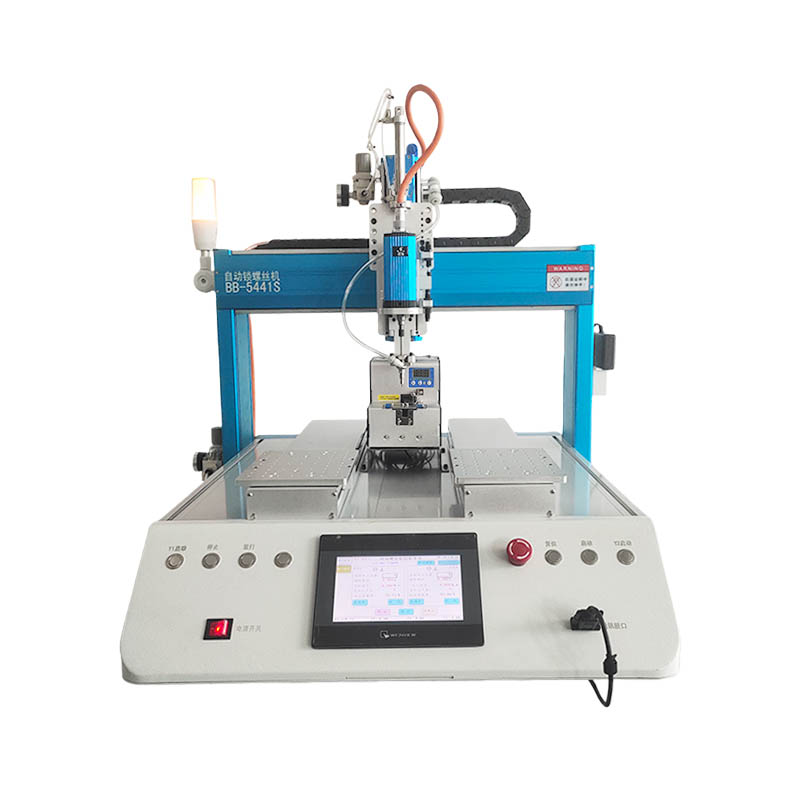
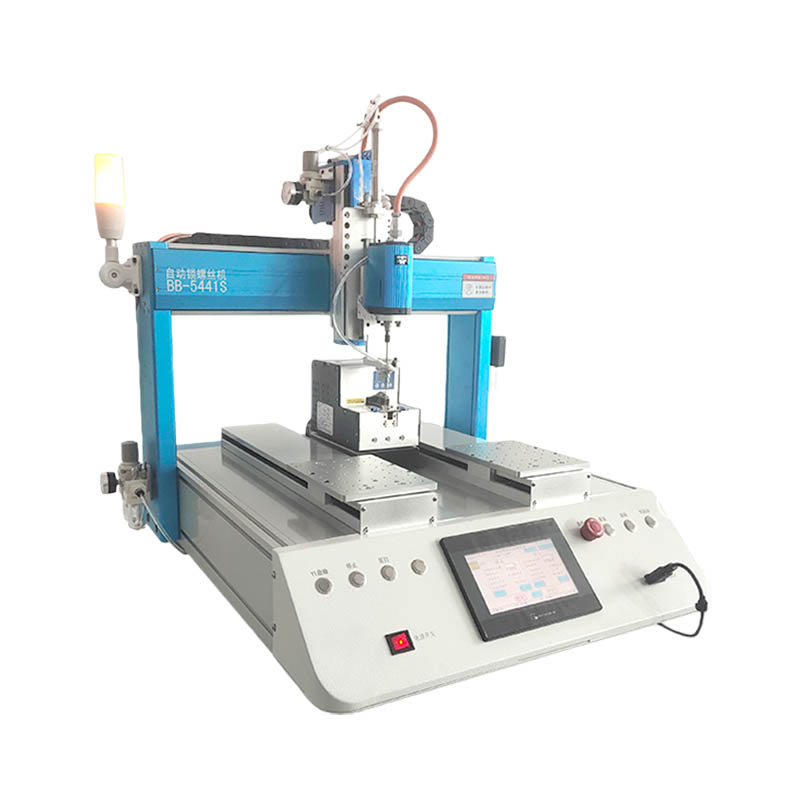
Traditional single-station automatic screw fastening machines require downtime after fastening a product, waiting for manual loading and unloading, creating a significant "downtime" that severely restricts overall cycle time. The double-platform fully automatic screw machine, through its independent dual Y-axis platform design, completely breaks this bottleneck. Two worktables can operate synchronously and alternately: while platform A is performing high-precision screw fastening, the operator can safely and easily load and unload workpieces on platform B; once platform A completes its work, the system seamlessly switches to platform B for fastening, while platform A enters loading and unloading mode. This cycle repeats, reducing product placement time to almost zero and increasing overall machine efficiency by 40%–60%. More importantly, this design not only increases productivity but also significantly optimizes the human-machine collaboration experience. Operators no longer need to risk approaching the fastening area while the equipment is running, significantly improving operational safety; simultaneously, the dual-platform structure supports a "one person, multiple machines" management mode, further reducing reliance on manpower and aligning with lean manufacturing principles.

2. High-Precision Motion System: A Stable and Reliable "Mechanical Hand"
Screw fastening requires extremely high positioning accuracy, especially in the assembly of tiny electronic components, where a deviation of ±0.02mm can lead to stripped threads, loose screws, or even PCB damage. To address this, the equipment employs a high-level configuration combination in its X/Y/Z three-axis drive system: the X/Y axes utilize servo motors and precision ball screws to ensure rigidity and repeatability under high-speed operation; the Z axis flexibly combines stepper motors and synchronous belts or servo motors and ball screws depending on load requirements, ensuring both response speed and vertical downward pressure control. Crucially, the entire machine is equipped with an automatic error compensation mechanism. Through laser calibration or real-time feedback of position deviations from high-precision grating rulers, the control system dynamically corrects accumulated errors, maintaining sub-millimeter-level locking consistency even under prolonged continuous operation or fluctuating ambient temperatures. This closed-loop "sensing-feedback-correction" mechanism ensures excellent stability even during 24/7 high-intensity production.
3. Intelligent Screw Feeding: Overcoming Material and Size Limitations
Traditional screw feeding methods have long been limited by screw characteristics: pneumatic blowing is difficult to handle short, thick screws with an aspect ratio less than 1.2; magnetic vibratory feeders are incompatible with non-magnetic stainless steel screws. The double-platform fully automatic screw machine innovatively adopts a vacuum screw feeding system, which uses negative pressure adsorption to grasp screws, completely eliminating reliance on screw magnetism or aspect ratio. Whether it's a miniature M1.0 stainless steel screw or an irregularly shaped countersunk screw, it can stably feed them, significantly improving versatility. The core feeding mechanism is a rotary four-segment indexing mechanism, which is compact and operates quietly. Each 90° rotation of the rotary table completes a "picking-sorting-detection-dispatch" cycle, with photoelectric sensors monitoring the screw's position in real time, eliminating the risk of missing or jammed screws. Thanks to its fully enclosed design and the use of low-wear materials, the system requires almost no daily maintenance, effectively reducing downtime and maintenance costs.
4. DPS+ Handheld Programmer: A Flexible and Efficient "Smart Brain"
Facing the flexible production needs of multiple varieties and small batches, the ease of programming the equipment is crucial. This machine is equipped with a DPS+ handheld programmer, providing a fully graphical Chinese interface with operation logic close to human habits. Users simply hold the teach pendant and lightly tap key points along the product fastening path; the system will automatically generate the trajectory program. Even more powerful is its program cloning function—for the same type of product, programming only needs to be done once, and the program can be copied to other equipment of the same model with one click, enabling rapid production line replication. Internal storage capacity reaches up to 1000 sets of screw feeding programs, supporting management by product model. When switching orders, operators only need to call the corresponding program number, and the equipment automatically matches the screw parameters, tightening torque, running speed, and other process data, truly achieving "one-click model changeover" and significantly shortening production line changeover time.
5. Fully Chinese Intelligent Control System: Transparent Production Management
The equipment is equipped with a self-developed fully automatic screw tightening control system, using a fully Chinese operating interface, greatly reducing the operating threshold. During operation, the screen dynamically displays the current workstation, screw number, tightening status, torque value, and abnormal alarm information. The tightening result of each screw is recorded in real time and traceable, supporting the generation of quality reports and providing a data foundation for SPC. When abnormalities such as stripped threads, floating locks, or missed locks occur, the system immediately marks it as "NG" and can trigger audible and visual alarms or pause the production line to prevent defective products from flowing into the next process. This end-to-end management capability, characterized by visualization, traceability, and intervention, not only improves product consistency but also lays the foundation for data collection and analysis in intelligent manufacturing.
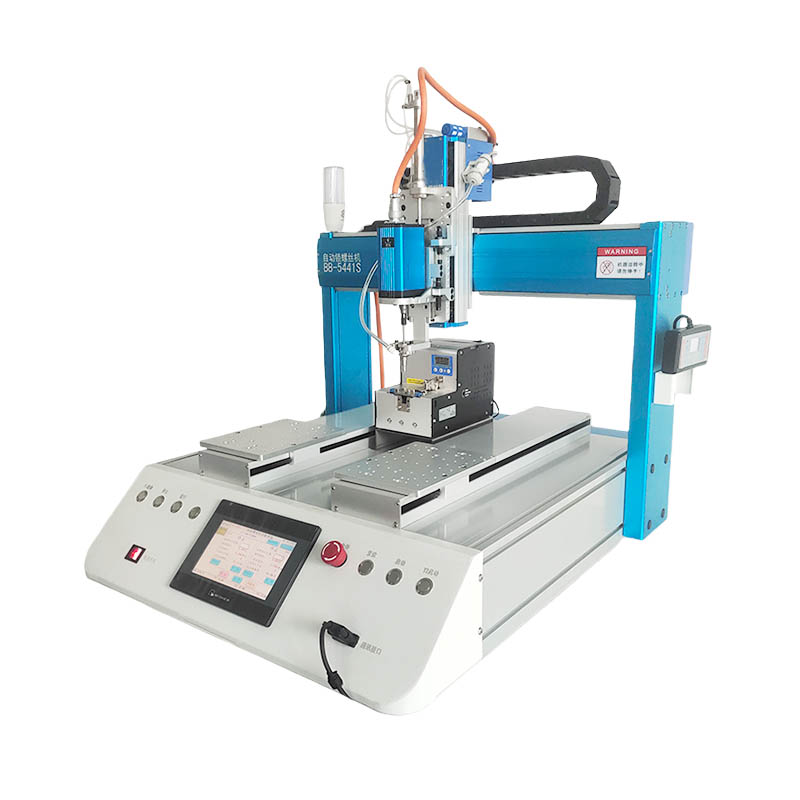
The double-platform fully automatic screw machine is far more than a simple combination of machines; it represents a system-level innovation integrating mechatronics, intelligent control, ergonomics, and industrial software. It overcomes efficiency bottlenecks with its dual-platform architecture, safeguards assembly quality with a high-precision motion system, breaks through material limitations with vacuum feeding, empowers flexible manufacturing with intelligent programming, and ensures a closed-loop quality control system. In today's manufacturing landscape where "quality improvement, cost reduction, and efficiency enhancement" are core demands, this equipment, with its perfect synergy of efficiency and precision, is helping companies move from automation to intelligent manufacturing, injecting strong momentum into high-end manufacturing.
1. Dual Y-axis Platform: The Core Engine for Efficiency Leap
Traditional single-station automatic screw fastening machines require downtime after fastening a product, waiting for manual loading and unloading, creating a significant "downtime" that severely restricts overall cycle time. The double-platform fully automatic screw machine, through its independent dual Y-axis platform design, completely breaks this bottleneck. Two worktables can operate synchronously and alternately: while platform A is performing high-precision screw fastening, the operator can safely and easily load and unload workpieces on platform B; once platform A completes its work, the system seamlessly switches to platform B for fastening, while platform A enters loading and unloading mode. This cycle repeats, reducing product placement time to almost zero and increasing overall machine efficiency by 40%–60%. More importantly, this design not only increases productivity but also significantly optimizes the human-machine collaboration experience. Operators no longer need to risk approaching the fastening area while the equipment is running, significantly improving operational safety; simultaneously, the dual-platform structure supports a "one person, multiple machines" management mode, further reducing reliance on manpower and aligning with lean manufacturing principles.
2. High-Precision Motion System: A Stable and Reliable "Mechanical Hand"
Screw fastening requires extremely high positioning accuracy, especially in the assembly of tiny electronic components, where a deviation of ±0.02mm can lead to stripped threads, loose screws, or even PCB damage. To address this, the equipment employs a high-level configuration combination in its X/Y/Z three-axis drive system: the X/Y axes utilize servo motors and precision ball screws to ensure rigidity and repeatability under high-speed operation; the Z axis flexibly combines stepper motors and synchronous belts or servo motors and ball screws depending on load requirements, ensuring both response speed and vertical downward pressure control. Crucially, the entire machine is equipped with an automatic error compensation mechanism. Through laser calibration or real-time feedback of position deviations from high-precision grating rulers, the control system dynamically corrects accumulated errors, maintaining sub-millimeter-level locking consistency even under prolonged continuous operation or fluctuating ambient temperatures. This closed-loop "sensing-feedback-correction" mechanism ensures excellent stability even during 24/7 high-intensity production.
3. Intelligent Screw Feeding: Overcoming Material and Size Limitations
Traditional screw feeding methods have long been limited by screw characteristics: pneumatic blowing is difficult to handle short, thick screws with an aspect ratio less than 1.2; magnetic vibratory feeders are incompatible with non-magnetic stainless steel screws. The double-platform fully automatic screw machine innovatively adopts a vacuum screw feeding system, which uses negative pressure adsorption to grasp screws, completely eliminating reliance on screw magnetism or aspect ratio. Whether it's a miniature M1.0 stainless steel screw or an irregularly shaped countersunk screw, it can stably feed them, significantly improving versatility. The core feeding mechanism is a rotary four-segment indexing mechanism, which is compact and operates quietly. Each 90° rotation of the rotary table completes a "picking-sorting-detection-dispatch" cycle, with photoelectric sensors monitoring the screw's position in real time, eliminating the risk of missing or jammed screws. Thanks to its fully enclosed design and the use of low-wear materials, the system requires almost no daily maintenance, effectively reducing downtime and maintenance costs.
4. DPS+ Handheld Programmer: A Flexible and Efficient "Smart Brain"
Facing the flexible production needs of multiple varieties and small batches, the ease of programming the equipment is crucial. This machine is equipped with a DPS+ handheld programmer, providing a fully graphical Chinese interface with operation logic close to human habits. Users simply hold the teach pendant and lightly tap key points along the product fastening path; the system will automatically generate the trajectory program. Even more powerful is its program cloning function—for the same type of product, programming only needs to be done once, and the program can be copied to other equipment of the same model with one click, enabling rapid production line replication. Internal storage capacity reaches up to 1000 sets of screw feeding programs, supporting management by product model. When switching orders, operators only need to call the corresponding program number, and the equipment automatically matches the screw parameters, tightening torque, running speed, and other process data, truly achieving "one-click model changeover" and significantly shortening production line changeover time.
5. Fully Chinese Intelligent Control System: Transparent Production Management
The equipment is equipped with a self-developed fully automatic screw tightening control system, using a fully Chinese operating interface, greatly reducing the operating threshold. During operation, the screen dynamically displays the current workstation, screw number, tightening status, torque value, and abnormal alarm information. The tightening result of each screw is recorded in real time and traceable, supporting the generation of quality reports and providing a data foundation for SPC. When abnormalities such as stripped threads, floating locks, or missed locks occur, the system immediately marks it as "NG" and can trigger audible and visual alarms or pause the production line to prevent defective products from flowing into the next process. This end-to-end management capability, characterized by visualization, traceability, and intervention, not only improves product consistency but also lays the foundation for data collection and analysis in intelligent manufacturing.
The double-platform fully automatic screw machine is far more than a simple combination of machines; it represents a system-level innovation integrating mechatronics, intelligent control, ergonomics, and industrial software. It overcomes efficiency bottlenecks with its dual-platform architecture, safeguards assembly quality with a high-precision motion system, breaks through material limitations with vacuum feeding, empowers flexible manufacturing with intelligent programming, and ensures a closed-loop quality control system. In today's manufacturing landscape where "quality improvement, cost reduction, and efficiency enhancement" are core demands, this equipment, with its perfect synergy of efficiency and precision, is helping companies move from automation to intelligent manufacturing, injecting strong momentum into high-end manufacturing.