


How does a double-platform fully automatic screw machine ensure zero-conflict operation and seamless cycle time between two workstations?
Release Time : 2025-12-15
In the consumer electronics manufacturing industry, rapid product iteration, numerous models, and high assembly precision place extremely high demands on the flexibility, efficiency, and reliability of automated equipment. The double-platform fully automatic screw machine, with its parallel operation mode of "screwing on one side and loading/unloading on the other," has become a key piece of equipment for improving production line cycle time. It is suitable for dozens of types of small electronic products, including mobile phones, watches, VR glasses, laptops, and LED lighting, and can quickly switch products simply by changing the fixtures. However, achieving "non-interference and seamless coordination" between the two workstations during high-speed operation relies on a precise mechanical structure, an intelligent control system, and highly optimized timing logic.

1. Dual Y-axis Platforms: Physical Isolation + Time Staggering, Building a Natural Foundation for Collaboration
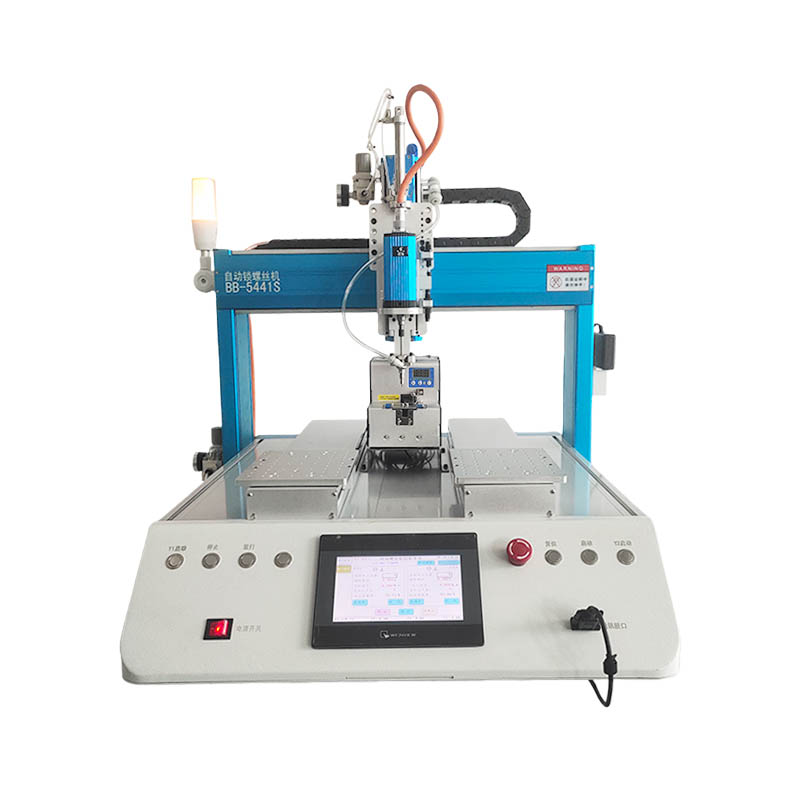
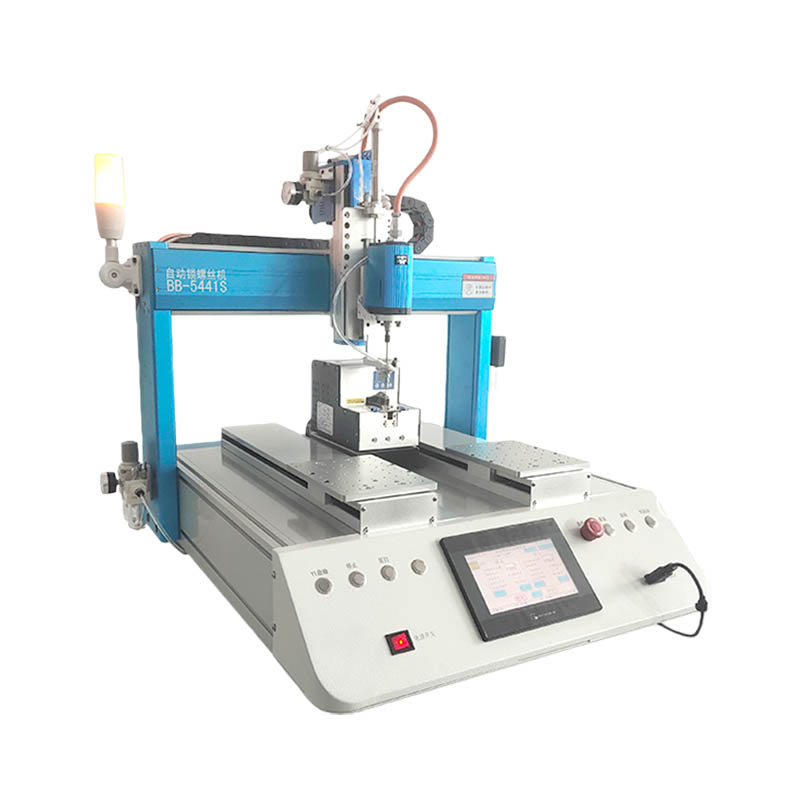
The core of this equipment lies in its dual independent Y-axis platform design. The two worktables are installed on the left and right sides respectively, and can move independently along the Y-axis. When the left platform enters the screw-screwing area, the right platform simultaneously moves to the operator's loading/unloading area; and vice versa. This spatial separation and functional zoning layout physically eliminates the risk of human-machine interference and platform collisions.
More importantly, the system uses a precise timing scheduling algorithm to ensure strict staggered operation between the two platforms:
Locking Phase: Platform A positions itself, presses down on the Z-axis, and locks simultaneously across multiple axes;
Synchronous Operation: Platform B completes material handling, fixture reset, and safety door closure;
Switching Moment: Both platforms complete their actions almost simultaneously, rapidly exchanging positions on the X/Y axes to enter the next cycle.
The entire process requires no waiting, truly achieving "uninterrupted locking and uninterrupted feeding," reducing the non-productive time of 30%–50% in traditional single-platform equipment to near zero.
2. High-Precision Drive and Error Compensation: Ensuring Positioning Consistency at High Speeds
To support high-frequency, high-precision alternating operation, the equipment uses a combination of servo motors and ball screws or stepper motors and synchronous belts on the X/Y/Z axes, and integrates an automatic error compensation mechanism. For example, the Y-axis repeatability accuracy can reach ±0.01mm, ensuring that the deviation between the screwdriver bit and the screw hole center is less than 0.02mm after each platform is in position, avoiding stripping or eccentric tightening.
Furthermore, the system automatically performs "zero-return verification" or "visual-assisted correction" before each platform switch. Even if minor mechanical drift occurs during long-term operation, it can dynamically correct it, ensuring that the two stations maintain synchronous accuracy after thousands of cycles.
3. Intelligent Control System: Unified Scheduling, Real-time Monitoring, Error-Proofing
The equipment is equipped with a self-developed, fully Chinese automatic screw tightening control system, which acts as the "brain" to coordinate the actions of both platforms. Its core functions include:
Dynamic Status Display: Real-time display of the current process on both platforms;
Programmed Cycle Management: Automatically matching product process parameters based on 1000 preset programs using the DPS+ handheld programmer;
Closed-Loop Feedback of Tightening Results: After each screw is tightened, the system determines OK/NG and records it. If a station experiences consecutive NGs, it can automatically pause that side of the platform to avoid batch defects, while the other platform continues to operate, maximizing production capacity. This "divide and conquer, combine and control" strategy ensures that the two platforms operate independently yet collaboratively, with a near-zero probability of conflict.
4. Flexible Feeding and Rapid Changeover: Supporting Seamless Switching Between Multiple Product Categories
The equipment employs a vacuum screw feeding system, overcoming the limitations of traditional pneumatic or magnetic feeding on screw material and aspect ratio, and is compatible with screws from M1.0 to M5.0. Combined with a rotary four-segment indexing feeding mechanism, feeding is quiet, reliable, and maintenance-free.
When switching products, the operator only needs to change the clamps, nozzles, and bits, and call the corresponding program—the entire process can be completed within 5 minutes. Since the two platforms share the same locking module and control system, product changes do not affect the collaborative logic; the new program automatically adapts to the dual-station cycle time, achieving "product change without changing rhythm."
5. Safety and Ergonomics: Ensuring Operational Safety Under High Efficiency
The equipment is equipped with multiple protection mechanisms, including safety light curtains, dual-circuit emergency stop, and platform positioning interlocks. When the operator loads material on the right platform, the left locking area automatically closes; conversely, the opposite occurs. This "interlocked human-machine partitioning" design ensures personnel safety while preventing platform conflicts due to misoperation.
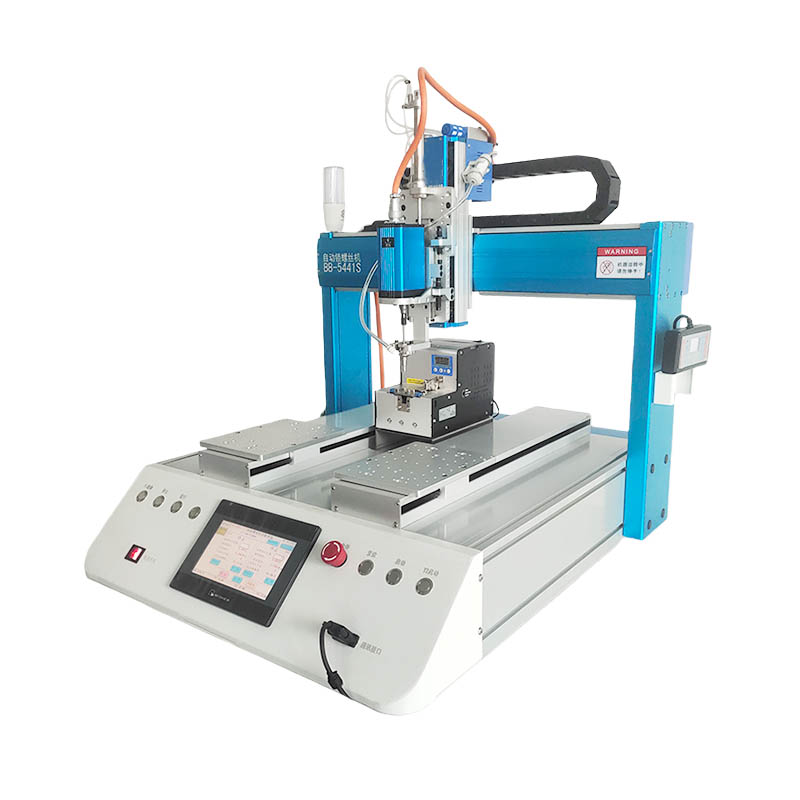
The "zero-conflict, seamless integration" of the double-platform fully automatic screw machine is not simply an addition of a workbench, but the result of deep integration of mechanics, control, software, and processes. Through physical isolation of dual Y-axis, high-precision drives, an intelligent scheduling system, and a flexible feeding architecture, it maintains a locking accuracy of ±0.02mm while improving overall equipment efficiency (OEE) by over 40%. In the new normal of "small batches, multiple varieties, and fast delivery" in consumer electronics, this efficient, flexible, and reliable dual-platform collaborative model is becoming an indispensable core unit of intelligent manufacturing production lines.
1. Dual Y-axis Platforms: Physical Isolation + Time Staggering, Building a Natural Foundation for Collaboration
The core of this equipment lies in its dual independent Y-axis platform design. The two worktables are installed on the left and right sides respectively, and can move independently along the Y-axis. When the left platform enters the screw-screwing area, the right platform simultaneously moves to the operator's loading/unloading area; and vice versa. This spatial separation and functional zoning layout physically eliminates the risk of human-machine interference and platform collisions.
More importantly, the system uses a precise timing scheduling algorithm to ensure strict staggered operation between the two platforms:
Locking Phase: Platform A positions itself, presses down on the Z-axis, and locks simultaneously across multiple axes;
Synchronous Operation: Platform B completes material handling, fixture reset, and safety door closure;
Switching Moment: Both platforms complete their actions almost simultaneously, rapidly exchanging positions on the X/Y axes to enter the next cycle.
The entire process requires no waiting, truly achieving "uninterrupted locking and uninterrupted feeding," reducing the non-productive time of 30%–50% in traditional single-platform equipment to near zero.
2. High-Precision Drive and Error Compensation: Ensuring Positioning Consistency at High Speeds
To support high-frequency, high-precision alternating operation, the equipment uses a combination of servo motors and ball screws or stepper motors and synchronous belts on the X/Y/Z axes, and integrates an automatic error compensation mechanism. For example, the Y-axis repeatability accuracy can reach ±0.01mm, ensuring that the deviation between the screwdriver bit and the screw hole center is less than 0.02mm after each platform is in position, avoiding stripping or eccentric tightening.
Furthermore, the system automatically performs "zero-return verification" or "visual-assisted correction" before each platform switch. Even if minor mechanical drift occurs during long-term operation, it can dynamically correct it, ensuring that the two stations maintain synchronous accuracy after thousands of cycles.
3. Intelligent Control System: Unified Scheduling, Real-time Monitoring, Error-Proofing
The equipment is equipped with a self-developed, fully Chinese automatic screw tightening control system, which acts as the "brain" to coordinate the actions of both platforms. Its core functions include:
Dynamic Status Display: Real-time display of the current process on both platforms;
Programmed Cycle Management: Automatically matching product process parameters based on 1000 preset programs using the DPS+ handheld programmer;
Closed-Loop Feedback of Tightening Results: After each screw is tightened, the system determines OK/NG and records it. If a station experiences consecutive NGs, it can automatically pause that side of the platform to avoid batch defects, while the other platform continues to operate, maximizing production capacity. This "divide and conquer, combine and control" strategy ensures that the two platforms operate independently yet collaboratively, with a near-zero probability of conflict.
4. Flexible Feeding and Rapid Changeover: Supporting Seamless Switching Between Multiple Product Categories
The equipment employs a vacuum screw feeding system, overcoming the limitations of traditional pneumatic or magnetic feeding on screw material and aspect ratio, and is compatible with screws from M1.0 to M5.0. Combined with a rotary four-segment indexing feeding mechanism, feeding is quiet, reliable, and maintenance-free.
When switching products, the operator only needs to change the clamps, nozzles, and bits, and call the corresponding program—the entire process can be completed within 5 minutes. Since the two platforms share the same locking module and control system, product changes do not affect the collaborative logic; the new program automatically adapts to the dual-station cycle time, achieving "product change without changing rhythm."
5. Safety and Ergonomics: Ensuring Operational Safety Under High Efficiency
The equipment is equipped with multiple protection mechanisms, including safety light curtains, dual-circuit emergency stop, and platform positioning interlocks. When the operator loads material on the right platform, the left locking area automatically closes; conversely, the opposite occurs. This "interlocked human-machine partitioning" design ensures personnel safety while preventing platform conflicts due to misoperation.
The "zero-conflict, seamless integration" of the double-platform fully automatic screw machine is not simply an addition of a workbench, but the result of deep integration of mechanics, control, software, and processes. Through physical isolation of dual Y-axis, high-precision drives, an intelligent scheduling system, and a flexible feeding architecture, it maintains a locking accuracy of ±0.02mm while improving overall equipment efficiency (OEE) by over 40%. In the new normal of "small batches, multiple varieties, and fast delivery" in consumer electronics, this efficient, flexible, and reliable dual-platform collaborative model is becoming an indispensable core unit of intelligent manufacturing production lines.