


How does an automatic dispensing machine handle the complex dispensing needs of components with different shapes?
Release Time : 2026-01-12
As new energy vehicle manufacturing moves towards higher precision, higher reliability, and lighter weight, adhesive bonding has become a core technology in key areas such as battery module packaging, electronic control unit sealing, and motor assembly fixing. Faced with components with highly complex geometries, diverse materials, and stringent processes, such as irregularly shaped curved surfaces of battery trays, porous structures of cell brackets, and microcavities of sensors, traditional manual or 2D dispensing equipment can no longer meet the requirements for consistency and efficiency. Automatic dispensing machines, with their spatially free path planning, millisecond-level dynamic response, and intelligent parameter control capabilities, are becoming "precision adhesive masters" in solving this problem, injecting new momentum into the intelligent and flexible manufacturing of new energy vehicle parts.

1. 3D Spatial Free Programming: Precise Fitting of Irregularly Shaped Surfaces
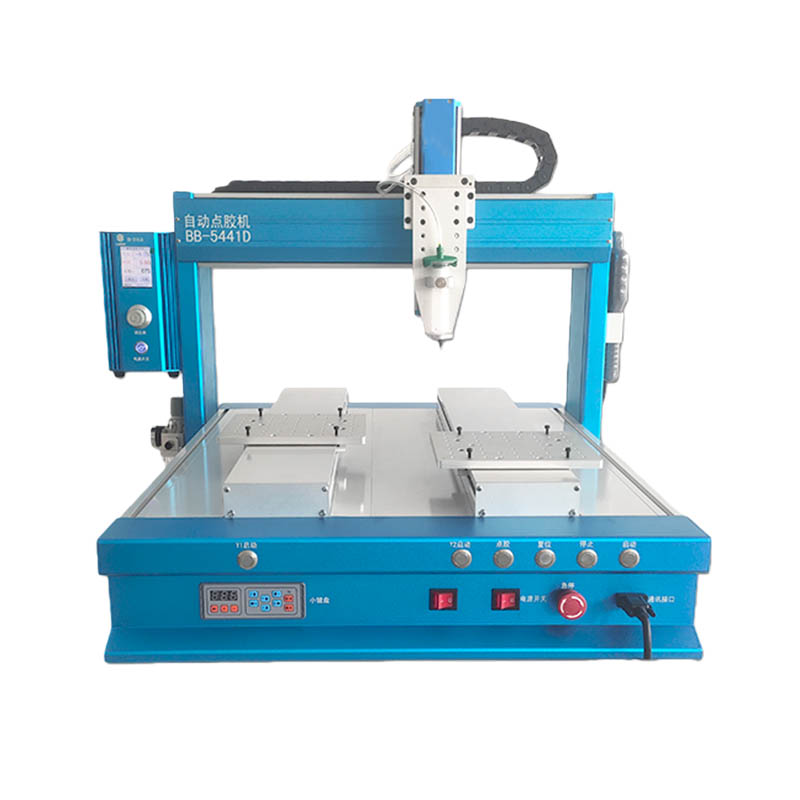
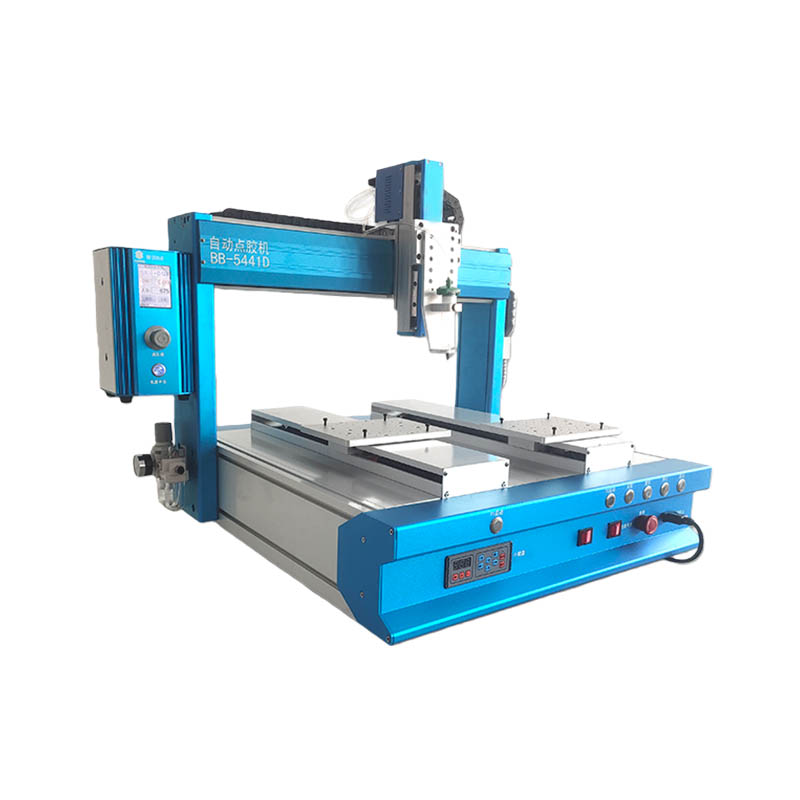
New energy vehicle parts are often made of die-cast aluminum alloys, injection-molded engineering plastics, or molded composite materials, with surfaces often containing curved surfaces, chamfers, deep grooves, or even hollow structures. The 3D arbitrary dispensing machine, through a high-precision servo motor and multi-axis linkage control system, can plan any trajectory in three-dimensional space—whether it's a continuous sealing line on the edge of a battery casing, dot-like potting between motor stator windings, or micron-level chip encapsulation on a BMS circuit board, all can be automatically generated by importing 3D models through CAD/CAM software. The system supports multiple modes such as spline curves, spiral paths, and reciprocating filling, ensuring the adhesive completely conforms to the workpiece contour, with no omissions or stacking, achieving precise "what you see is what you get" application.
2. Millisecond-level dynamic control: Adaptable to diverse adhesives and process windows
Different components have vastly different requirements for adhesive type, viscosity, and curing time. This equipment is equipped with a fully parameterized digital control platform, allowing independent settings for dispensing volume, adhesive layer thickness, dispensing speed, movement speed, and start/stop delay. For example, in sealing power battery liquid cooling plates, a low-speed, uniform application of high-viscosity thermally conductive adhesive is required to avoid air bubbles; while in camera module assembly, high-speed, micro-volume dispensing is needed to improve cycle time. The machine boasts a dispensing frequency of up to 280 times per second, achieving precise control across a wide range from nanoliters to milliliters when combined with piezoelectric valves or screw pump dispensing systems. Crucially, its automatic error correction function monitors the glue flow status in real time; upon detecting glue interruption, overflow, or positional deviation, it immediately pauses and issues an alarm, preventing batch defects.
3. 24/7 High-Efficiency Operation: Significantly Enhancing Production Line Flexibility and Economy
As an integrated device independently developed and molded, this dispensing machine is not only compact and stable in operation but also capable of 24/7 continuous operation. Compared to manual dispensing, efficiency is more than doubled, completely eliminating quality fluctuations caused by fatigue and experience differences. On a production line producing 100,000 sets of electric drive systems annually, a single machine can replace 3-4 skilled workers, saving over 300,000 yuan in labor costs annually. Simultaneously, its modular design supports rapid changeover—by recalling pre-stored programs, it can switch to a dispensing scheme for new parts within 10 minutes, greatly improving the production line's responsiveness to multi-variety, small-batch orders, perfectly aligning with the rapid iteration pace of new energy vehicle production.
4. High Integration and Traceability: Empowering Intelligent Manufacturing Upgrades
The equipment supports integration with MES systems, automatically recording dispensing parameters, timestamps, and operation logs for each batch of products, achieving end-to-end quality traceability. Combined with a vision positioning system, it can automatically compensate for incoming material deviations, ensuring operations are completed with a positioning accuracy of ±0.02mm. This "perception-decision-execution" closed loop transforms the dispensing process from "experience-driven" to "data-driven," laying the foundation for building a digital factory.
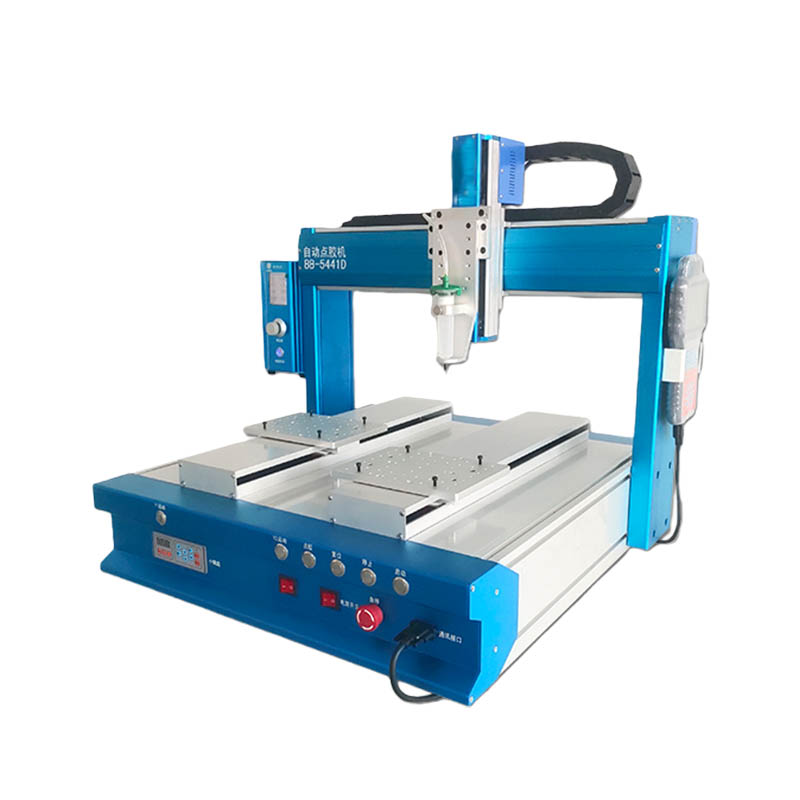
The 3D arbitrary dispensing automatic dispensing machine is not merely an upgrade in tools, but a revolution in manufacturing logic. With its spatial freedom, temporal precision, and intelligent adaptability, it transforms complex adhesive processes into reliable and efficient automated workflows. In every sealing, bonding, and potting step of new energy vehicle components, it silently safeguards safety, performance, and quality—making the invisible link of "adhesive" a solid support behind green travel.
1. 3D Spatial Free Programming: Precise Fitting of Irregularly Shaped Surfaces
New energy vehicle parts are often made of die-cast aluminum alloys, injection-molded engineering plastics, or molded composite materials, with surfaces often containing curved surfaces, chamfers, deep grooves, or even hollow structures. The 3D arbitrary dispensing machine, through a high-precision servo motor and multi-axis linkage control system, can plan any trajectory in three-dimensional space—whether it's a continuous sealing line on the edge of a battery casing, dot-like potting between motor stator windings, or micron-level chip encapsulation on a BMS circuit board, all can be automatically generated by importing 3D models through CAD/CAM software. The system supports multiple modes such as spline curves, spiral paths, and reciprocating filling, ensuring the adhesive completely conforms to the workpiece contour, with no omissions or stacking, achieving precise "what you see is what you get" application.
2. Millisecond-level dynamic control: Adaptable to diverse adhesives and process windows
Different components have vastly different requirements for adhesive type, viscosity, and curing time. This equipment is equipped with a fully parameterized digital control platform, allowing independent settings for dispensing volume, adhesive layer thickness, dispensing speed, movement speed, and start/stop delay. For example, in sealing power battery liquid cooling plates, a low-speed, uniform application of high-viscosity thermally conductive adhesive is required to avoid air bubbles; while in camera module assembly, high-speed, micro-volume dispensing is needed to improve cycle time. The machine boasts a dispensing frequency of up to 280 times per second, achieving precise control across a wide range from nanoliters to milliliters when combined with piezoelectric valves or screw pump dispensing systems. Crucially, its automatic error correction function monitors the glue flow status in real time; upon detecting glue interruption, overflow, or positional deviation, it immediately pauses and issues an alarm, preventing batch defects.
3. 24/7 High-Efficiency Operation: Significantly Enhancing Production Line Flexibility and Economy
As an integrated device independently developed and molded, this dispensing machine is not only compact and stable in operation but also capable of 24/7 continuous operation. Compared to manual dispensing, efficiency is more than doubled, completely eliminating quality fluctuations caused by fatigue and experience differences. On a production line producing 100,000 sets of electric drive systems annually, a single machine can replace 3-4 skilled workers, saving over 300,000 yuan in labor costs annually. Simultaneously, its modular design supports rapid changeover—by recalling pre-stored programs, it can switch to a dispensing scheme for new parts within 10 minutes, greatly improving the production line's responsiveness to multi-variety, small-batch orders, perfectly aligning with the rapid iteration pace of new energy vehicle production.
4. High Integration and Traceability: Empowering Intelligent Manufacturing Upgrades
The equipment supports integration with MES systems, automatically recording dispensing parameters, timestamps, and operation logs for each batch of products, achieving end-to-end quality traceability. Combined with a vision positioning system, it can automatically compensate for incoming material deviations, ensuring operations are completed with a positioning accuracy of ±0.02mm. This "perception-decision-execution" closed loop transforms the dispensing process from "experience-driven" to "data-driven," laying the foundation for building a digital factory.
The 3D arbitrary dispensing automatic dispensing machine is not merely an upgrade in tools, but a revolution in manufacturing logic. With its spatial freedom, temporal precision, and intelligent adaptability, it transforms complex adhesive processes into reliable and efficient automated workflows. In every sealing, bonding, and potting step of new energy vehicle components, it silently safeguards safety, performance, and quality—making the invisible link of "adhesive" a solid support behind green travel.