


How are automatic dispensing machines redefining the boundaries of modern manufacturing processes with precise dispensing?
Release Time : 2026-02-02
In the sealing of new energy vehicle battery modules, the encapsulation of photovoltaic modules, the fixing of LED beads, the bonding of internal components in smartwatches, and even the assembly of high-end home appliances and furniture hardware, the application of minute amounts of adhesive, seemingly insignificant, directly determines the product's sealing performance, structural strength, electrical insulation, and lifespan. Traditional manual dispensing struggles to meet the requirements of high consistency, high efficiency, and complex paths. Automatic dispensing machines—especially intelligent dispensing equipment with three-dimensional spatial movement capabilities—are becoming indispensable "precision hands" on high-end manufacturing production lines, quietly propelling industrial bonding processes into a new era of intelligent manufacturing with their millimeter-level precision, flexible programming, and autonomous error correction capabilities.
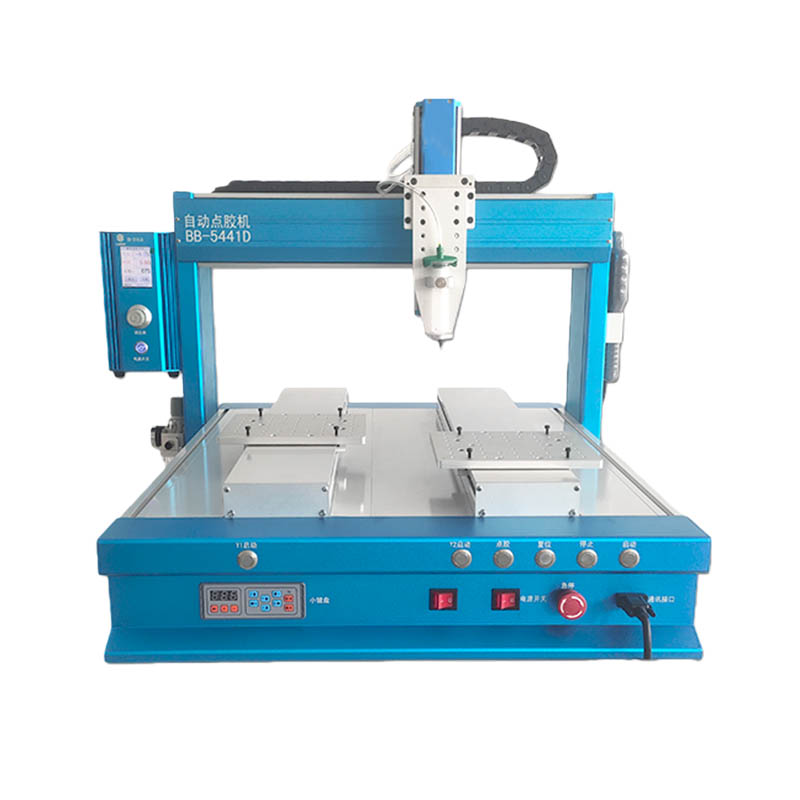
The core of an automatic dispensing machine lies in its precise control of spatial trajectories. Through a high-rigidity gantry or robotic arm structure, coupled with servo motors and high-resolution encoders, the equipment can move freely in the X, Y, and Z dimensions, achieving the drawing of adhesive paths for arbitrary curves, arcs, spirals, and even three-dimensional contours. Whether it's filling the bottom of microchips on a circuit board or applying continuous sealing strips to the edges of large battery packs, the system can output stably according to a preset program, ensuring uniform adhesive application, accurate positioning, and no stringing or breaks in the adhesive. This capability enables integrated packaging of complex products, significantly improving yield and production efficiency.
Its intelligence is not only reflected in motion control but also in closed-loop feedback and adaptive adjustment. Some high-end models integrate a vision recognition system that can automatically locate the workpiece reference point before dispensing, compensating for incoming material deviations. During dispensing, pressure sensors and flow monitoring modules provide real-time feedback on the adhesive status. Once blockages, bubbles, or abnormal dispensing are detected, the system can automatically pause, issue an alarm, or initiate a cleaning program to avoid batch defects. This "perception-judgment-response" capability significantly reduces reliance on operator experience and ensures stability during long-term operation.
The wide range of application scenarios confirms its universal technological value. In the new energy sector, it provides highly reliable structural and thermally conductive adhesives for power batteries, ensuring cell safety and thermal management efficiency. In the photovoltaic industry, precise dispensing ensures a strong bond between junction boxes and backplanes, resisting decades of outdoor weathering. In consumer electronics manufacturing, micro-volume dispensing is sufficient for the precise fixing of camera modules, speakers, or flexible circuits. In smart home hardware production, it meets high-volume demands with its high-speed operation. Regardless of industry changes, the automatic dispensing machine consistently uses adhesive as a medium to connect materials and functions.
The equipment design also considers human-machine collaboration and flexible production. The modular adhesive supply system supports quick-change cartridges or drum-type dispensing, adapting to adhesives of different viscosities and curing methods. The user-friendly interface allows for quick switching of product models via CAD import or teach-in programming. Protective covers and safety light curtains ensure operational safety. These details allow the equipment to be integrated into fully automated production lines or flexibly deployed as a semi-automatic workstation.
The deeper significance lies in the fact that automatic dispensing machines represent a shift in manufacturing logic from "experience-driven" to "data-driven." Every optimization of the dispensing path and every calibration of the glue volume is based on a deep understanding of the material's rheological properties and process windows. It is not merely a machine, but a carrier of process knowledge, solidifying engineers' wisdom into repeatable and traceable digital processes.
In an era pursuing lightweight, miniaturization, and high reliability, adhesive bonding has evolved from an auxiliary process to a core manufacturing process. Automatic dispensing machines, with silent precision, construct a safety barrier and performance foundation for products at the microscopic scale. When a drop of glue is accurately delivered to its designated location, it bonds not only two parts, but also the relentless pursuit of ultimate quality in modern manufacturing—because true precision often lies hidden in unseen seams; and true intelligence begins with respect for every microliter of glue.
The core of an automatic dispensing machine lies in its precise control of spatial trajectories. Through a high-rigidity gantry or robotic arm structure, coupled with servo motors and high-resolution encoders, the equipment can move freely in the X, Y, and Z dimensions, achieving the drawing of adhesive paths for arbitrary curves, arcs, spirals, and even three-dimensional contours. Whether it's filling the bottom of microchips on a circuit board or applying continuous sealing strips to the edges of large battery packs, the system can output stably according to a preset program, ensuring uniform adhesive application, accurate positioning, and no stringing or breaks in the adhesive. This capability enables integrated packaging of complex products, significantly improving yield and production efficiency.
Its intelligence is not only reflected in motion control but also in closed-loop feedback and adaptive adjustment. Some high-end models integrate a vision recognition system that can automatically locate the workpiece reference point before dispensing, compensating for incoming material deviations. During dispensing, pressure sensors and flow monitoring modules provide real-time feedback on the adhesive status. Once blockages, bubbles, or abnormal dispensing are detected, the system can automatically pause, issue an alarm, or initiate a cleaning program to avoid batch defects. This "perception-judgment-response" capability significantly reduces reliance on operator experience and ensures stability during long-term operation.
The wide range of application scenarios confirms its universal technological value. In the new energy sector, it provides highly reliable structural and thermally conductive adhesives for power batteries, ensuring cell safety and thermal management efficiency. In the photovoltaic industry, precise dispensing ensures a strong bond between junction boxes and backplanes, resisting decades of outdoor weathering. In consumer electronics manufacturing, micro-volume dispensing is sufficient for the precise fixing of camera modules, speakers, or flexible circuits. In smart home hardware production, it meets high-volume demands with its high-speed operation. Regardless of industry changes, the automatic dispensing machine consistently uses adhesive as a medium to connect materials and functions.
The equipment design also considers human-machine collaboration and flexible production. The modular adhesive supply system supports quick-change cartridges or drum-type dispensing, adapting to adhesives of different viscosities and curing methods. The user-friendly interface allows for quick switching of product models via CAD import or teach-in programming. Protective covers and safety light curtains ensure operational safety. These details allow the equipment to be integrated into fully automated production lines or flexibly deployed as a semi-automatic workstation.
The deeper significance lies in the fact that automatic dispensing machines represent a shift in manufacturing logic from "experience-driven" to "data-driven." Every optimization of the dispensing path and every calibration of the glue volume is based on a deep understanding of the material's rheological properties and process windows. It is not merely a machine, but a carrier of process knowledge, solidifying engineers' wisdom into repeatable and traceable digital processes.
In an era pursuing lightweight, miniaturization, and high reliability, adhesive bonding has evolved from an auxiliary process to a core manufacturing process. Automatic dispensing machines, with silent precision, construct a safety barrier and performance foundation for products at the microscopic scale. When a drop of glue is accurately delivered to its designated location, it bonds not only two parts, but also the relentless pursuit of ultimate quality in modern manufacturing—because true precision often lies hidden in unseen seams; and true intelligence begins with respect for every microliter of glue.