


In the packaging of new energy vehicle battery modules, how does an automatic dispensing machine ensure the uniformity and consistency of thermally conductive adhesive or sealant?
Release Time : 2026-02-09
With the rapid development of the new energy vehicle industry, the power battery, as a core component, directly affects the overall vehicle quality in terms of safety, heat dissipation performance, and sealing reliability. During battery module packaging, thermally conductive adhesive is used to improve the heat transfer efficiency between the cell and the cooling plate, while sealant plays a crucial role in dustproofing, waterproofing, and corrosion prevention. Uneven coating, uncontrolled thickness, or defects such as adhesive breaks or bubbles in these two types of adhesives will seriously affect battery life and even lead to the risk of thermal runaway. Automatic dispensing machines, with their intelligent parameter adjustment, high-speed stable operation, and real-time error correction capabilities, have become key technical equipment for ensuring the uniformity and consistency of adhesives.
1. Precise and controllable process parameters ensure adhesive consistency
Automatic dispensing machines provide independent and precise control over the dispensing amount, adhesive layer thickness, dispensing time, and movement speed, specifically tailored to the complex structure of new energy vehicle battery modules. For example, when applying thermally conductive adhesive to the cooling plate grooves, the system automatically matches the valve opening time and platform movement speed according to the groove width, ensuring a constant adhesive amount per unit area. When applying sealant to the module housing seams, a closed-loop pressure control system maintains a stable adhesive flow rate, preventing uneven adhesive lines due to drops in the adhesive tank level or temperature fluctuations. This highly programmable parameter system ensures consistent bonding quality across different batches and models of battery modules.
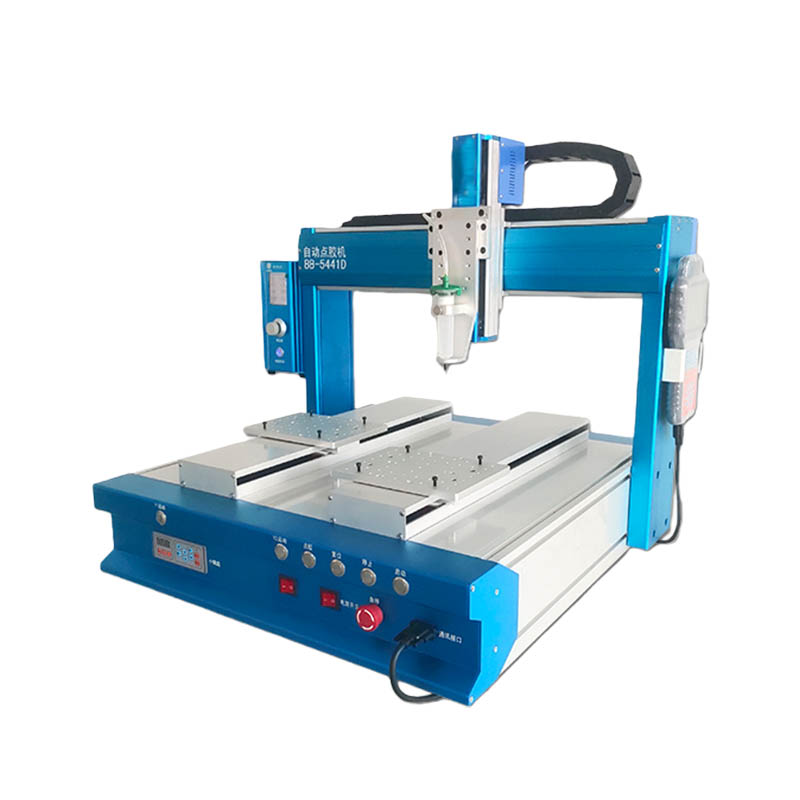
2. High-Speed, High-Precision Motion Platform Achieves Full Coverage of Complex Paths
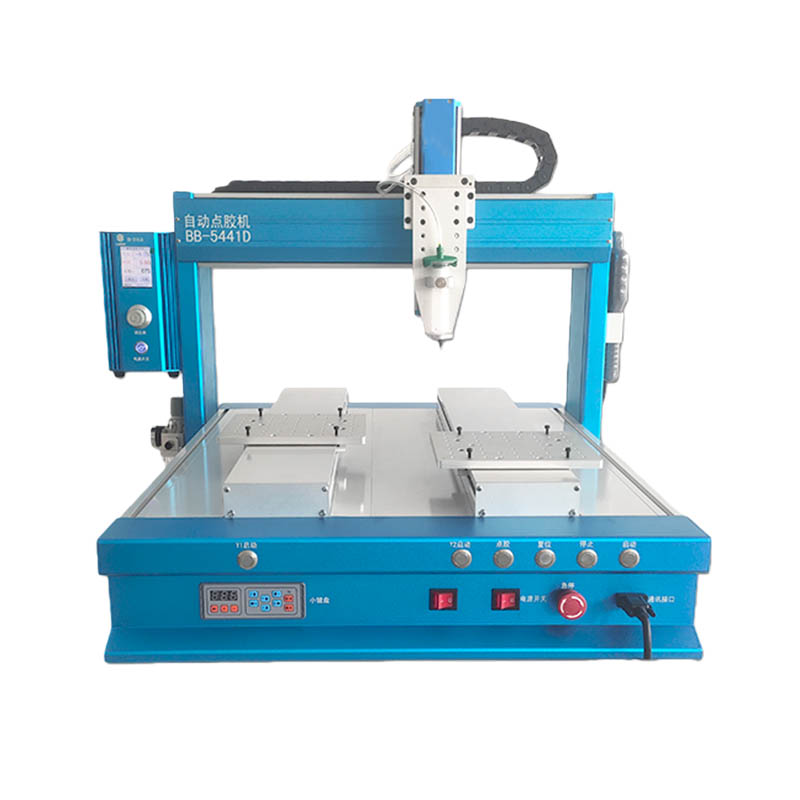
Thanks to its independently developed high-speed motion control system, this dispensing machine operates significantly faster than manual operation, with a dispensing frequency of up to 280 times per second, enabling rapid response to complex trajectory commands. In battery module packaging, continuous adhesive application along irregular curves, multiple corners, or three-dimensional steps is often required. The three-dimensional arbitrary dispensing machine, through XYZ three-axis linkage and rotary axis, accurately reproduces the adhesive path imported from CAD, ensuring continuous adhesive lines without breaks or accumulation at corners. Meanwhile, the machine boasts a compact design and robust structure, maintaining sub-millimeter positioning accuracy even under prolonged high-speed operation, fundamentally eliminating adhesive width fluctuations caused by mechanical vibration or lag.
3. Stable 24/7 Operation and Intelligent Error Correction Improve Yield
This equipment supports 24/7 continuous operation, reducing labor costs by over 50% and doubling overall production efficiency. More importantly, its built-in automatic error correction function significantly enhances process reliability. For example, by monitoring the adhesive line morphology in real time through a vision system, the system can immediately pause operation, issue alarms, and even automatically compensate for missing sections once adhesive breaks, overflows, or deviations are detected. Some high-end models can also dynamically adjust air pressure parameters using an adhesive viscosity sensor to address material rheological property drift caused by changes in environmental temperature and humidity. This "sensing-judgment-response" closed-loop mechanism effectively ensures a high degree of consistency in the adhesive sealing quality of each battery module.
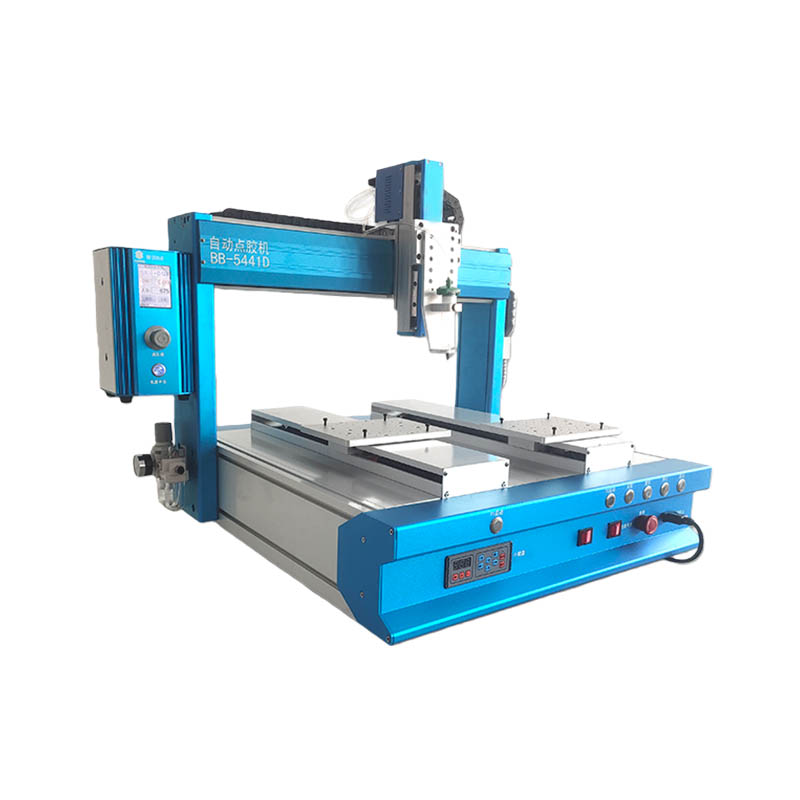
4. Broad Adaptability Supports Multiple Application Scenarios
Besides new energy vehicle batteries, this 3D dispensing platform has been successfully applied in several demanding fields, including solar photovoltaic junction box sealing, LED module potting, and circuit board conformal coating. Its flexible and comprehensive dispensing parameter library and modular valve design allow for rapid switching between thermally conductive or sealing materials suitable for different systems such as silicone, polyurethane, and epoxy resin. This combination of versatility and specialization enables the equipment to not only meet current battery packaging standards but also continuously serve the precision bonding needs of next-generation solid-state batteries or integrated CTB structures as technology iterates and upgrades.
With the increasingly stringent safety and performance requirements of new energy vehicles, automatic dispensing machines have transformed from auxiliary equipment into a core process ensuring the reliability of battery modules. Through high-precision parameter control, high-speed 3D path execution, intelligent real-time error correction, and stable all-weather operation, the 3D arbitrary dispensing machine truly achieves "uniform, continuous, and consistent" coating of thermally conductive and sealing adhesives under complex working conditions, providing solid technical support for efficient heat dissipation and long-term sealing of power batteries.
1. Precise and controllable process parameters ensure adhesive consistency
Automatic dispensing machines provide independent and precise control over the dispensing amount, adhesive layer thickness, dispensing time, and movement speed, specifically tailored to the complex structure of new energy vehicle battery modules. For example, when applying thermally conductive adhesive to the cooling plate grooves, the system automatically matches the valve opening time and platform movement speed according to the groove width, ensuring a constant adhesive amount per unit area. When applying sealant to the module housing seams, a closed-loop pressure control system maintains a stable adhesive flow rate, preventing uneven adhesive lines due to drops in the adhesive tank level or temperature fluctuations. This highly programmable parameter system ensures consistent bonding quality across different batches and models of battery modules.
2. High-Speed, High-Precision Motion Platform Achieves Full Coverage of Complex Paths
Thanks to its independently developed high-speed motion control system, this dispensing machine operates significantly faster than manual operation, with a dispensing frequency of up to 280 times per second, enabling rapid response to complex trajectory commands. In battery module packaging, continuous adhesive application along irregular curves, multiple corners, or three-dimensional steps is often required. The three-dimensional arbitrary dispensing machine, through XYZ three-axis linkage and rotary axis, accurately reproduces the adhesive path imported from CAD, ensuring continuous adhesive lines without breaks or accumulation at corners. Meanwhile, the machine boasts a compact design and robust structure, maintaining sub-millimeter positioning accuracy even under prolonged high-speed operation, fundamentally eliminating adhesive width fluctuations caused by mechanical vibration or lag.
3. Stable 24/7 Operation and Intelligent Error Correction Improve Yield
This equipment supports 24/7 continuous operation, reducing labor costs by over 50% and doubling overall production efficiency. More importantly, its built-in automatic error correction function significantly enhances process reliability. For example, by monitoring the adhesive line morphology in real time through a vision system, the system can immediately pause operation, issue alarms, and even automatically compensate for missing sections once adhesive breaks, overflows, or deviations are detected. Some high-end models can also dynamically adjust air pressure parameters using an adhesive viscosity sensor to address material rheological property drift caused by changes in environmental temperature and humidity. This "sensing-judgment-response" closed-loop mechanism effectively ensures a high degree of consistency in the adhesive sealing quality of each battery module.
4. Broad Adaptability Supports Multiple Application Scenarios
Besides new energy vehicle batteries, this 3D dispensing platform has been successfully applied in several demanding fields, including solar photovoltaic junction box sealing, LED module potting, and circuit board conformal coating. Its flexible and comprehensive dispensing parameter library and modular valve design allow for rapid switching between thermally conductive or sealing materials suitable for different systems such as silicone, polyurethane, and epoxy resin. This combination of versatility and specialization enables the equipment to not only meet current battery packaging standards but also continuously serve the precision bonding needs of next-generation solid-state batteries or integrated CTB structures as technology iterates and upgrades.
With the increasingly stringent safety and performance requirements of new energy vehicles, automatic dispensing machines have transformed from auxiliary equipment into a core process ensuring the reliability of battery modules. Through high-precision parameter control, high-speed 3D path execution, intelligent real-time error correction, and stable all-weather operation, the 3D arbitrary dispensing machine truly achieves "uniform, continuous, and consistent" coating of thermally conductive and sealing adhesives under complex working conditions, providing solid technical support for efficient heat dissipation and long-term sealing of power batteries.